Monday, December 12, 2016

Kahne and Westheimer: In the Service of What?

Throughout the piece In the Service of What? The Politics of Service Learning, Joseph Kahne and Joel Westheimer discuss the affects of service learning on students and the community as a whole. They define service learning as learning which, "makes students active participants in service projects that aim to respond to the needs of the community while furthering the academic goals of students". This includes a variety of opportunities and projects, from working with the homeless to working with the environment. Either way they are working to look beyond themselves and help those around them in the form of service. The question that Kahne and Westheimer are aiming to answer though, is whether or not this service is actually helping, having an effect, and causing change, or if it is just an act of charity. 

They begin to focus on the fact that while these acts of service are good in nature, the goal of the project needs to be established and lined up with the project. While being progressive is good, they say "more attention has been focused on moving forward than on asking where we are headed".  Kahne and Westheimer then discuss how it is necessary to ask question the values of the projects, what relationships are being formed, what society is being lead towards, and other underlying issues in the service learning project. 

helping-others.jpg (600×400)This then comes down to the aspects of Charity vs. Change. Kahne and Westheimer compare various different service learning projects which were done in classrooms. The service project "Serving Those in Need", done in Mr. Johnson's classroom exemplified acts of charity. Through this project they provided time and fulfill their "civic duty" and built a sense of altruism. It was a temporary project, which paid no attention to the the greater system at hand and helping to fix it. Very much like Kozol's idea of putting a band-aid on a broken leg. 

The other project done in Ms. Adam's classroom involved analyzing the system and causes of the homelessness issue as a whole, including the impacts it has, the difficulties faced by those involved. The project involved discussion and self analysis as well as the analysis of the overall systematic issue. This situation falls more into the idea of a change focused service learning project. Focus is placed on the idea of creating a lasting change, both in the system itself, as well as in the ideas and minds of the students in the classroom. 

There is not specifically a right or wrong answer in regards to having a service learning experience which is charity focused or change focused, as long as it aligns specifically with what kind of service learning experience you are aiming to achieve. In the original formation of the Service learning aspect, the goal was for students to be able to "recognize that their academic abilities and collective commitments could help them respond in meaningful ways to a variety of social concerns". These situations are the ones which are charity based, the focus is placed solely on the student and their response to things in the future.
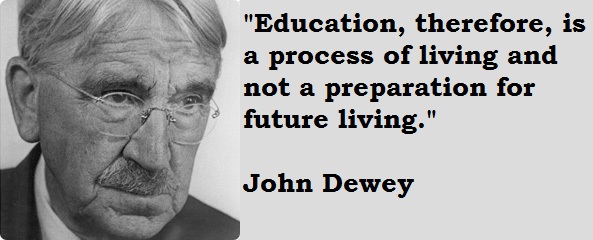


john-deweys-quotes-1.jpg (593×240)
John Dewey was one of the main advocates for
the change style of Service Learning.
On the other hand, those Service Learning projects focused which fall under the 
change category were focused not only on where the child is now, but also where they are going and what they can do. This was explained by Lawernce Cremin saying, "by manipulating the school curriculum, they could ultimately change the world".  Through this project, they are bringing up discussions of systematic change to be able to make a greater difference throughout our society. They are making the most out of this possibility, rather than just settling at a positive feeling left behind from an act of charity. 

These charity acts are not completely dissociated with future change, and often times charity works as a stepping stone towards future change. Whether it is just an aspect of a change project or it is a project done alongside that of change, the positivity expressed and created through charity acts can act as a benefactor to that of change. Charity on it's own is also not negative and the positivity in it is still valued, but when that charity is viewed as change and nothing more is done with it, then that is where a problem my arise. 


Promising Practices


The first part of the Promising Practices conference on November 5th, was lead by keynote speaker Robert Brooks. Throughout his speech, he discussed the "The Power of Mindsets: Strategies to Nurture Resilience". He told stories throughout his life as a psychologist and educator, and how they apply to helping build resiliency in students. One aspect which he put a lot of focus on was he importance of being a "charismatic adult". He describes this person as one who can connect and relate to a student on both a professional and emotional level. This allows the students' to create an emotional connection not only to the adult but also to the information and education which is being taught, as well as creating a positive feeling. 


This idea of a charismatic adult ties greatly into the topic of my first workshop which was titled "Social and Emotional Learning (SEL): Developing A Common Cross Cultural Language". The workshop was lead by Soraya Gomes, a Hispanic woman, and Kathleen Nerstheimer, a white woman. In regards to the way the program was run, I felt that it was very disorganized, they had a lot of information they tried to push into an hour so nothing was too in-depthly discussed. We were handed a thick packet of information to follow 

social-and-emotional-learning-core-competencies.png (1000×1000)along with the power point, as well as a link to a website with a compilation of other sources related to the discussion. This allowed me to dive more into the content which was discussed afterwards and get more out of it than just what was presented.  They focused on discussing the idea of SEL which is a way to create a learning atmosphere both in adults as well as students which is socially and emotionally aware. This involved being self-aware, knowing how to self-manage, being socially aware, having proper relationship skills, and being able to make responsible decisions. In regards to being socially aware, they discussed the importance of being aware of the social situations around you and being able to empathize with those of different cultures and social standings. While this relates back to the majority of our class, it specifically relates the most to Johnson and his discussion of the necessity of being socially aware in regards to privilege in order to make any progress or change. This also relates back to Delpit and the necessity of teaching the rules and codes of power. Through SEL, students are learning the aspects needed for success in the future. On the same page of Delpit, the different types of teaching, the indirect white teaching style and direct teaching style were very visible in the way the two women went about presenting the information in the presentation. They pulled a lot of attention to it, explaining how through SEL, teachers are able to utilize both and know how to approach the students at hand rather than having a specific style used at all times. 

Through following this, Teachers are relating in that professional yet emotionally understanding way, characterizing them as the "Charismatic adults" Brooks exemplified earlier in his speech. Also, through being these "charismatic adults" and creating a space where the students feel emotionally engaged as well as safe, this is helping to create a safe space in the classroom or community they are working in, which as August explains helps further learning, in many of the same ways exemplified by Brooks. 

colored-wooden-letter-blocks-white-background-13816996.jpg (400×267)
My second session was titled "Building Resiliency Through Play". I was not provided as much information in this session, but it was very interactive and fun, and the information provided was valuable. We opened up with different cray hand shakes which forced many of us out of our comfort zones, as well as forced us to interact with those around the room. We then did an activity which required us to find a partner and hold three blocks together with just our index fingers, and then go around and try to keep our blocks up, while trying to knock down those of the people around you. We then split up to play various other games, such as operation, Jenga, and a game called Builders and Bulldozers. In Builders and Bulldozers, there where a few builders building block towers three blocks high and everyone else going around and knocking down the towers, as the game went on more and more people were added and the rolls of builder or bulldozer were constantly changing. Afterwards, we discussed the various games we played and how these activities all had a sense of risk to them, but that when portrayed properly, it can encourage students to know how to handle situations of failure properly rather than negatively, as well as helping to promote social relationships and positives through resiliency.  Kristen Pepin, a professor here at RIC who led the program also provided resources of books containing various ideas filled with different games and activities which can be enacted to help build resiliency through acts of play in children.  


Thursday, December 8, 2016

Pecha Kucha

https://docs.google.com/presentation/d/1VsXDakEOxo-vvWfIPkHXfVaoPpp4NapUeyRlahrDMdc/pub?start=false&loop=false&delayms=20000

Monday, November 28, 2016

Christensen- Blog Post


In her piece, Unlearning the Myths That Bind Us , Linda Christensen discusses the underlying messages, described by author Ariel Dorfman as a "secret education",  found in children's media such as books, TV shows, and movies. 

Christensen describes how this secret education "instructs young people to accept the world as it is portrayed in these  social blue prints. And often that world depicts the domination of one sex, one race, one class, or one country over a weaker counterpart" (126). This is the same one sex, race, class, and country which makes up Leslie Grinner's SCWAAMP. This information which is portrayed captivates and manipulates the views of societal members at a very young age. Growing up children only experience first hand their own way of life, their race, their culture, their social class, etc., and therefore to formulate an opinion of other cultures, that information is received second hand through various forms of media. Due to this these opinions are often formulated into stereotypes of these other cultures rather than fact. 

She then quotes Dorfman, who says, "we are also taught how to love, how to buy, how to conquer, how to forget the past and suppress the future. We are taught more than anything else, how not to rebel" (128). These media forces and the SCWAAMP-ness of them reinforce a society which only has one way to success. This relates back to Delpit and the culture of power. While it is shown through the media, it is wrapped in stereotypes which increases the value of the one culture of power, while decreasing the value of all others, making those rules and codes seem unattainable to those outside the culture of power. 

The majority of these stereotypes are most easily found in the older cartoons, where aspects are most blatantly portrayed. But it is also necessary to note that these stereotypes and the culture of power are still portrayed in the media today, you just need to use a more focused lens to locate and find them in some situations. Beyond the stereotypical representation, being accurately represented beyond just a background character itself is a rarity. A woman main character is hard enough to find, let alone a main character who is a woman of color, and even then having that be character be a strong established character is even more of a feat to find. 

One of Christensen's students wrote "Women who aren't white begin to feel left out and ugly because they never get to play the princess" (131). Controversy over Disney and their lack of proper representation in their princesses and movies is something which still is occurring and flourishing. In 2012 with the release of Disney's Frozen backlash broke out over the whitewashing of the native Scandanavians, as there was not a single person of color in the entirety of the movie, and the fact that it is a repeated pattern in Disney's movies. 

While searching for a picture of the story which Christensen mentioned
as representation, all the search results were still of a white Cinderella. 
As mentioned above, having a strong female lead character is something which is not easily found in children's media. Christensen explains how representation for women of color could be found in Mary Carter Smith's "Cindy Ellie, A Modern Fairy Tale", a retelling of the classic "Cinderella" where Cindy Ellie is a young black woman from East Baltimore. While it is a quality piece for representation, Christensen explains "if the race of the character is the only thing changing, injustices still remain" (132). The character of Cinderella is still only focused on winning a man, and her value is found in a transformation of beauty and consumption. While breaking down racial walls, typical gender stereotypes are still exemplified and young girls still see their only worth being found through getting the looks and getting the guy. 

Christensen focuses throughout on the importance of educating students about these issues in the media they have experienced their whole lives. While in many ways it is difficult for students to come to the realization that their perceptions of the world have been manipulated by the media, it allows for the beginning of a change to be made. The enlightenment to the manipulation of representation and views in the media moves beyond just that and is made applicable to other aspects of life and those walls and stereotypes can begin to be broken through and a change can begin to be made. 

Tuesday, November 22, 2016

Safe Spaces Blog Post


This is a Reflection post about Safe Spaces: Making Schools and communities Welcoming to LGBT Youth by Aneemarie Vaccaro, Gerri August, and Megan S. Kennedy. 

This piece discusses the necessity and importance of having safe spaces for youth members of the LGBTQ+ community, specifically in educational settings. It explains, "To the extent that teachers, school administrators, and college professors create an atmosphere in which difference is not only tolerated but expected, explored, and embraced, students will be more likely to develop perspectives that result in respectful behaviors" (83). The piece then goes on to explain how without that kind of environment the SCWAAMP aspects of our society thrive, and those aspects that go against it, specifically the LGBTQ+ identity are assumed deviant. 


Me, age 13, in the "closet" at
 church camp.
While I am now an out member of the LGBTQ+ community, growing up I was raised in a Christian home and was a devout Baptist. With this being said, my knowledge of the LGBTQ+ community was almost nonexistent, and what I did know about it was that it was viewed as wrong, due to the opinions of the adults I had been surrounded by my whole life. By the time I reached high school the only time the topic came up was in my health class when we had a few guest speakers throughout the semester, two of whom were gay, one came in to discuss AIDS, and the other came from and LGBTQ youth center in Providence to talk just about the community itself as well as the center he works with and provide resources for anyone who would want them. While these two men were obviously not the first gay people I had met in my life, they were the first ones who I had ever met who talked about their experiences, and I was not very happy about it. Looking back I can quote my fourteen year old self saying "I don't have a problem with it, I just don't think they should be encouraging their lifestyle and they shouldn't be talking to a classroom about it". 

Throughout my experience in high school, beyond those two men who came to talk to my health class, the discussion of the LGBTQ+ community now nor its history were ever really discussed in the curriculum of the classroom. Through my own experiences I know that as I began to interact with a community of people who were open to and discussed the LGBTQ community and issues I found myself becoming more and more accepting, as well as realizing my own identity. Had the curriculum in the schools and school systems I had attended been more inclusive, I would have been able to begin to form a more open opinion from the beginning, and so could other students, and lessen issues of homophobia and heterosexism. 


The authors of this piece make another point following this saying, "Most educators do not set out to marginalize LGBT youth. They simply follow paths of least resistance. They put one foot in front of the other in what seems the natural, even the right, direction..." (84). Heterosexism is a norm in our society and often times is not given a second thought and is then applied to the curriculum in schools. Whether that is in classroom examples in stories, or word problems, or picture books, the people are almost always straight, and this furthers the continuation of heterosexism as well as not allowing a space to feel accepting to those LGBTQ students. With it being seen as the norm, it allows for teachers to use that as a crutch for not including it in their curriculum as they have just not thought otherwise, but changes need to be made to provide teachers with that information and allow them to have the knowledge to create a safe space in their classroom. 

Mapping the Authors Document


https://docs.google.com/document/d/10IM54txTnJLO49rjZxERnE1WKsuLIfo5Fjetzo_P0RQ/edit?usp=sharing

Sunday, November 13, 2016

The Problem We All Live With Blog post


Throughout this episode of This American Life; "The Problem We All Live With" Ira Glass talks with investigative reporter Nikole Hannah-Jones about the issues facing African American and Hispanic students in the United States Public school system. More specifically they focus on the solution of integration and how it is overall beneficial, but often ignored as a solution.

20130708_125533-400x300.jpg (400×300)
Hannah-Jones puts focus on the Normandy school district in Missouri, the school district which Michael Brown attended. She discusses Lesley McSpadden, Michael Browne's mom, who after her son was shot, one of the first things she said to the media was about how hard it was to get her son to graduate as a black man.  She writes, "Most black kids will not be shot by the police but many of them will go to a school like Michael Brown's...the school district he attended is almost completely black, almost completely poor, and failing badly" . Here she discusses how this school district represents many throughout the country, that students of color will attend and be segregated from the white students in the surrounding community. This is similar to a process which Kozol touches upon in Amazing Grace where he talks about the community of Mont Haven in the Bronx, and where a woman from that community says, "Clumping so many people, all with the same symptoms and same problems in one crowded place with nothing the can grow on? Our children start to mourn themselves before their time" (Kozol).  Whether it is in New York or Missouri, the institution of the United States works to pile more and more into one place to further prevent movement out of the lower class, or in this case to even be properly educated.


Once Normandy lost its accreditation and students were allowed to transfer to another school nearby, this brought about the accidental resurgence of integration in schools in Missouri. Hannah-Jones explains the positive aspects of integration and how it is beneficial for the students of color coming from the worse school district, and also does not
francis-howell-exterior-1ht-desktop-616-538.jpg (616×538)negatively affect the schooling scores of the students in the schools that students are being integrated into. But she also puts much of her focus on the struggles of getting to integration and why it is not the used solution today. For one, the school districts themselves furthered the explanation of institutions making it harder for students to be educated and raise out of a situation. When the Normandy school district needed to choose a school for their transfer students to go to, while they had a plethora of options and the school chose one which was over thirty miles away, making the option unappealing and harder for the students of Normandy. Also, those parents at the school chosen, Francis Howell, worked to try and make it as hard as possible for the Normandy Students to attend as well. One parent suggested, "Has anyone considered changing our school start times? Moving start times up 20 minutes, maybe 40 minutes? Making it a little less appealing?". Both of these school districts were doing whatever they could to put up road blocks for these students to prevent them from getting a proper education.

Bob Herbert of The New York Times wrote an article, "Separate and Unequal", further explaining the benefits of integration of schools, how test scores increase and the overall well being of poorer students increases when they go to school with middle class students. He then goes on to explain, "Studies have shown that it is not the race of the students that is significant, but rather the improved all-around environment of schools with better teachers, fewer classroom disruptions, pupils who are more engaged academically, parents who are more involved, and so on". But even though it is not the race of the students that is playing the significant role, it almost always is viewed as a racial issue.